GDPR Consent Checklist: A Compliance Framework for Fintechs
Ensure GDPR compliance with this strategic checklist. Learn how to manage consent, empower user rights, and build trust in a privacy-first era.


GDPR Consent: The Foundation of Digital Trust
For financial institutions and fintech platforms, data is more than a commodity; it is a liability. The General Data Protection Regulation (GDPR) fundamentally shifted the burden of proof from the user to the enterprise. It is no longer sufficient to bury consent within a Terms of Service agreement. In the current regulatory climate, consent must be explicit, informed, and demonstrable.
A checklist from Usercentrics outlines the granular requirements for compliant consent management. For C-Suite leaders and compliance officers, this is not merely a legal checkbox but a core component of operational resilience. Failing to adhere to these standards invites not only significant fines but also a catastrophic erosion of consumer trust.
Fyscal Technologies views GDPR compliance not as a constraint, but as an architectural mandate. By integrating these principles into your core systems a practice we call Compliance by Design you transform regulatory adherence from a recurring headache into a strategic asset.
The Problem: The Ambiguity of "Implicit" Consent
Many legacy systems were built on the premise of "implicit" consent the idea that by using a service, a customer agrees to data collection. Under GDPR, this model is obsolete.
The problem facing many enterprises today is that their data collection mechanisms are binary: they either collect everything or nothing. They lack the granularity to distinguish between essential operational data and non-essential marketing analytics.
This "all-or-nothing" approach creates two risks. First, it is non-compliant, as GDPR mandates granular choice. Second, it alienates privacy-conscious users who might consent to functional cookies but reject tracking pixels. Without a nuanced Consent Management Platform (CMP), you are forcing your users to make a choice that often results in them opting out entirely.
The Big Idea: Granular, Auditable Consent Architecture
Compliance requires a shift from passive collection to active management. This means implementing a system where consent is treated as a dynamic state, not a one-time event.
Your architecture must be able to:
- Capture explicit consent before any data is processed.
- Enforce that consent across all downstream systems immediately.
- Audit that consent history to prove compliance to regulators.
Based on the Usercentrics checklist, we have distilled the path to compliance into three strategic pillars.
Pillar 1: The Anatomy of Valid Consent
Consent is only valid if it meets specific criteria. It cannot be assumed, pre-ticked, or bundled.
- Explicit and Active: The user must take an affirmative action, such as clicking "Agree" or ticking a box. Pre-ticked boxes are explicitly banned.
- Granular: Users must be able to consent to specific purposes independently. They should be able to accept "Analytics" while rejecting "Marketing."
- Informed: The user must know who is collecting the data, what is being collected, and why. This information must be presented clearly, in plain language, before any collection occurs.
- Freely Given: Access to the service cannot be conditional on consenting to non-essential data processing. You cannot block a user from your app simply because they refused tracking cookies.
Strategic Implication: Review your current cookie banners and intake forms. If they rely on "implied" consent or bundled permissions, your architecture is non-compliant.
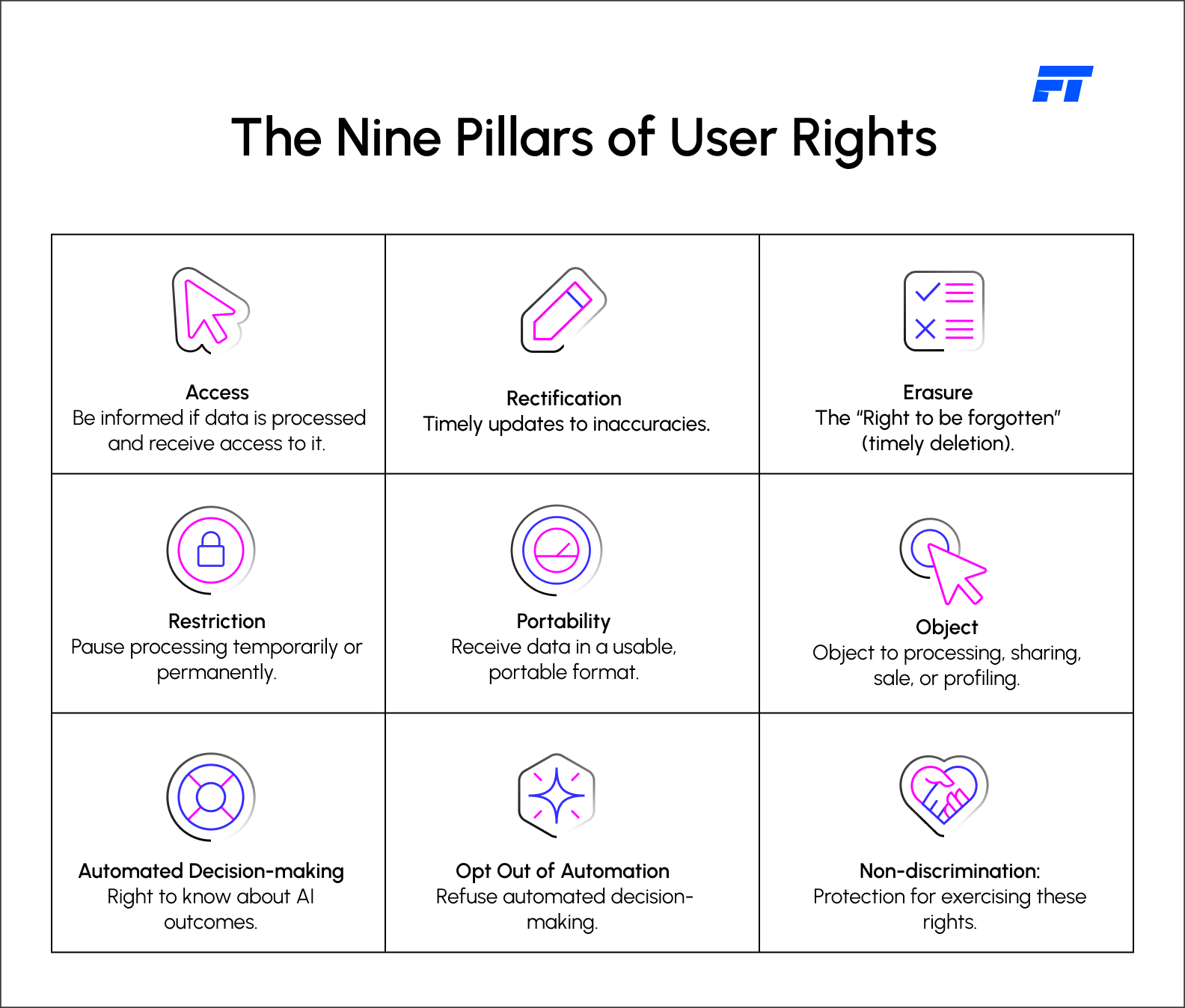
Pillar 2: Empowering User Rights
GDPR grants users specific rights over their data. Your systems must be engineered to fulfill these rights programmatically, not manually.
- Right to Withdraw: It must be as easy to withdraw consent as it is to give it. If it took one click to opt in, it should take one click to opt out.
- Right to Erasure (Right to be Forgotten): When a user requests deletion, your system must be able to purge their data from all active and backup systems in a timely manner.
- Right to Rectification: Users must be able to correct inaccuracies in their data.
- Right to Access and Portability: You must be able to provide a user with a copy of their data in a commonly used, machine-readable format.
Strategic Implication: Manual processing of Data Subject Access Requests (DSARs) is unscalable. You need automated workflows that can locate, compile, and manage user data across your entire stack.
Pillar 3: The Audit Trail and Maintenance
Documentation is your shield. In the event of an audit by Data Protection Authorities (DPA), the burden of proof lies with you.
- Secure Storage: You must securely record and store the consent preferences of every user.
- Proof of Consent: You must be able to demonstrate when and how a specific user gave consent for a specific processing activity.
- Regular Review: Privacy policies are not static. They must be reviewed every 12 months. If your processing partners or purposes change, you must re-acquire consent.
Strategic Implication: Treat consent logs as critical transaction data. They should be immutable, timestamped, and easily retrievable for auditing purposes.
Strategic Business Impact
Implementing a robust, granular consent architecture delivers value beyond compliance.
- Enhanced Brand Trust: Transparency builds confidence. Users are more likely to share data with institutions that respect their boundaries and offer clear choices.
- Operational Efficiency: Automating consent management and DSAR fulfillment reduces administrative overhead and minimizes the risk of human error.
- Future-Proofing: The principles of GDPR are becoming the global standard (e.g., CCPA in California, LGPD in Brazil). A GDPR-compliant architecture positions you for global expansion.
Conclusion
GDPR compliance is not a "set it and forget it" task. It is an ongoing operational commitment. The shift to a privacy-first world requires financial institutions to rethink how they architect their user interactions and data pipelines.
Fyscal Technologies specializes in building these compliant-by-design architectures. We help you implement the vendor-agnostic systems that ensure you can capture, manage, and prove consent without compromising on agility or user experience.
Ready to secure your compliance architecture?