Why CFOs Should Care About Payment Infrastructure, Not Just Rates
For years, CFOs have focused on transaction costs and interchange rates when it comes to payments. But in today’s financial landscape, it’s the infrastructure behind those payments not just the price per swipe that drives efficiency, resilience, and growth.


Introduction: Beyond the Cost Line
Payments have traditionally appeared on the CFO’s radar as a cost center. A few basis points saved on processing fees could make the difference in industries where margins are tight. But this narrow lens creates blind spots.
The truth is, payment infrastructure shapes much more than cost per swipe.
It affects cash flow, operational efficiency, compliance, and even customer experience. Treating payments as a line item to minimise overlooks their potential as a growth engine.
The Digital Imperative for CFOs
The global payments industry is expanding rapidly. McKinsey estimates that payments revenues reached $2.2 trillion in 2023, driven by e-commerce, cross-border trade, and embedded finance. At the same time, complexity is increasing: multiple payment rails, fragmented acquirers, and regulatory divergence across regions.
For CFOs, this creates both risk and opportunity. Accenture research shows that companies with modern payment infrastructure achieve up to 30% faster settlement cycles and lower fraud losses compared to peers relying on legacy systems. Faster access to cash improves liquidity; streamlined infrastructure reduces overhead. In this environment, focusing only on rates is like adjusting the paint color on a house while ignoring the cracks in the foundation.
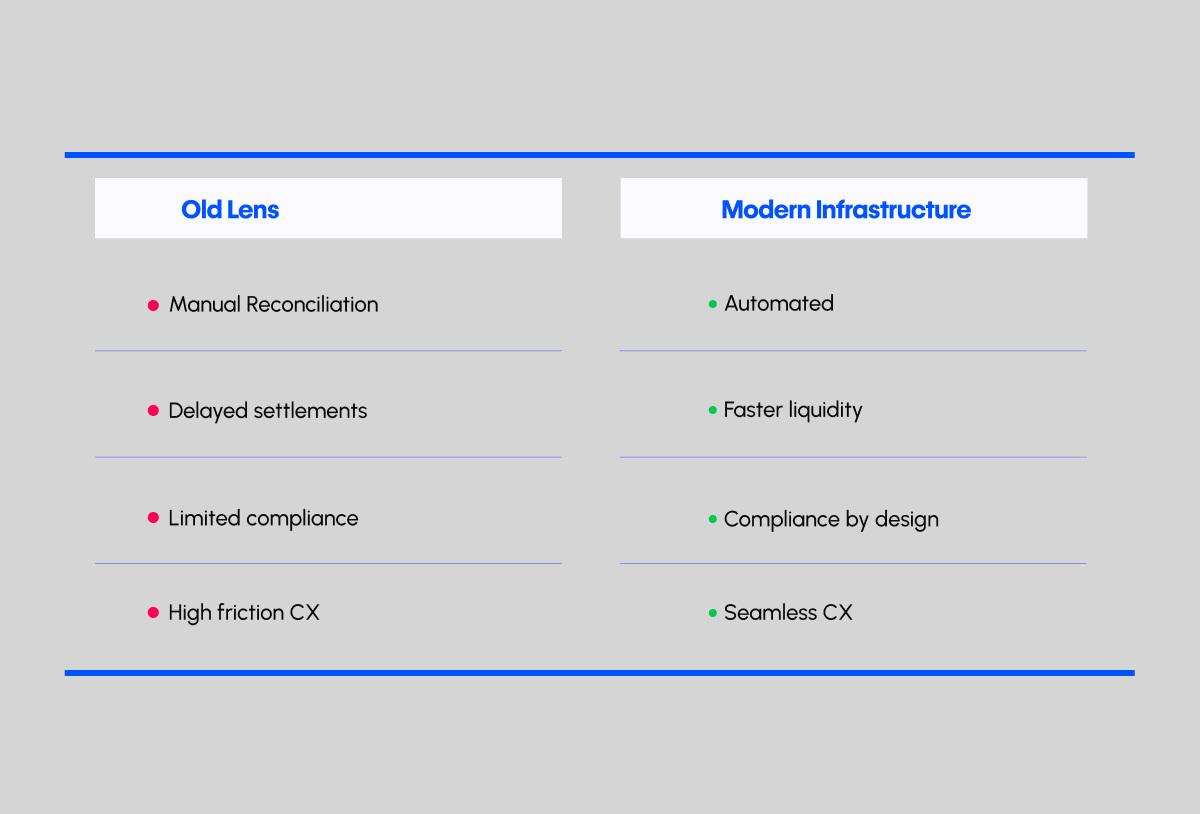
Why the Old Lens Holds CFOs Back
For years, CFOs have approached payments through a narrow lens: as a utility to be optimised for cost. The focus has been on lowering interchange, negotiating processing fees, and benchmarking rates against peers. In industries where margins are tight, this made sense. But as payments have grown more complex and central to business performance, this single-minded cost focus has become outdated.
The challenge is that what CFOs don’t see often costs more than what they do see. Beyond the rate sheet, inefficiencies hide in manual processes, outdated systems, and missed revenue opportunities. Treating payments purely as an expense line means overlooking the larger financial and strategic risks created by weak infrastructure.
Here’s how the old lens limits performance today:
- Efficiency at scale - API-driven integration automates reconciliation, reporting, and settlement, freeing finance teams from repetitive tasks.
- Liquidity gains - Smarter routing and local acquiring shorten settlement windows, bringing cash in faster and strengthening working capital.
- Revenue enablement - Higher acceptance rates even small uplifts add directly to top line growth. Accenture notes that a 1% increase in approval rates can boost revenue by 5–6% for large merchants.
- Risk management - Embedded fraud controls and compliance modules reduce exposure to penalties and chargebacks.
This isn’t just cost avoidance it’s value creation.
Strategic Areas CFOs Should Prioritise
- Settlement Speed and Liquidity - Settlement times vary widely depending on infrastructure. Modern platforms enable same-day or near-instant settlement, compared to multi-day delays with legacy systems. For CFOs, faster access to funds improves cash forecasting, reduces reliance on credit lines, and strengthens resilience during downturns.
- Acceptance Rates and Revenue Protection - Every failed payment is lost revenue. Optimised routing, local acquiring, and network tokenisation can reduce false declines and raise acceptance. A Bain study found that companies optimising acceptance achieved revenue uplifts of up to 10%, a figure that dwarfs any marginal fee savings.
- Data and Real-Time Insights - Traditional systems batch data, delaying visibility. Modern infrastructures stream payment data in real time, giving CFOs clearer insights into revenue, liquidity, and risk. This real-time lens enables faster decision-making and better forecasting.
- Compliance by Design - With regulations shifting across jurisdictions, compliance can’t be bolted on. Infrastructure must embed requirements like SCA, GDPR, or PCI from the start. Vendor-agnostic solutions ensure flexibility across markets without constant custom rebuilds.
- Customer Experience as a Financial Metric - Payment experience is often treated as a CX issue, but it has bottom-line consequences. A smoother, faster checkout increases conversion and repeat purchases. CFOs who view payments through this lens align finance with growth.
The Road Ahead: The CFO Mandate
The role of CFOs has evolved from financial gatekeeper to strategic partner. Payments are part of that shift. In the next 12–24 months, expect:
- Payments moving from cost line to boardroom topic: Boards will demand visibility into payment infrastructure performance, not just rates.
- Profit-center models: CFOs will look to monetise payment rails through interchange, FX optimisation, or embedded finance.
- Closer CFO–CIO collaboration: As payments become infrastructure, finance and tech leaders must align on modernisation priorities.
Those who adapt now will position their organisations for growth and resilience. Those who delay risk hidden costs, compliance penalties, and revenue leakage.
Conclusion: Infrastructure is the True Lever
Negotiating lower rates will always matter, but it’s no longer the whole story. The real opportunity for CFOs lies in modernising payment infrastructure accelerating settlement, raising acceptance, embedding compliance, and aligning payments with business growth. Payments are not just an operational cost. They are a strategic asset. The CFOs who recognise this will move beyond incremental savings to unlock resilience, efficiency, and revenue.