Why Wallet-Based Loyalty Programs Outperform Traditional Schemes
Traditional loyalty programs worked well in their time, but today they feel slow, generic, and disconnected from how customers actually shop. Wallet-based loyalty programs deliver instant, simple, and meaningful rewards that customers love and businesses can measure.


Loyalty at a Crossroads
Loyalty programs were once the ultimate customer retention tool. They gave people a reason to keep coming back whether that meant collecting miles for the next free flight, or swiping a coffee card to earn the tenth cup free. For years, these programs offered businesses predictable repeat sales and gave customers a sense of extra value.
But the landscape has changed. Today’s customers expect instant rewards, mobile-first journeys, and offers tailored to their needs. Traditional loyalty systems built around delayed points, physical cards, and siloed data are struggling to deliver. Businesses are spending more to maintain them, while engagement and redemption rates keep dropping.
According to Deloitte, nearly half of consumers feel traditional loyalty programs don’t deliver enough value to keep them engaged, and Accenture finds that brands with digital-first, personalised loyalty see up to 3x more participation. The evidence is clear: it’s time to modernise.
Wallet-based loyalty programs are that modernisation. By embedding rewards directly into digital wallets, they turn loyalty from a side activity into a seamless part of every transaction.
Loyalty Programs: The Original Idea
Loyalty programs were first introduced as a simple but powerful idea: give customers something extra for choosing your brand, and they’ll keep coming back. Airlines pioneered this in the late 1970s with frequent flyer miles, turning repeat travel into future perks. Retailers and coffee shops followed with punch cards and “buy 10, get 1 free” systems. The idea spread quickly because it worked: people enjoyed being rewarded, and businesses gained repeat revenue.
For businesses, these programs served multiple purposes. They weren’t just about discounts they created data trails on customer habits, helped segment frequent buyers, and built emotional connection through the feeling of being valued. In the 1990s and 2000s, as consumer choice expanded, loyalty programs became the standard retention tool across industries.
But these programs were built for a slower, less digital world. Customers were willing to wait for rewards, and carrying a physical card was seen as normal. In that environment, the original model thrived. Today, with digital-first expectations, those foundations no longer hold.
The Traditional Schemes We’ve Used
Most traditional loyalty programs were built on two familiar structures: points systems and tier-based memberships.
- Points systems Customers earned points every time they made a purchase, which could later be redeemed for rewards. This system dominated retail and hospitality for years. But the catch was time customers often needed months of spending before they could access meaningful benefits. According to Capgemini, 54% of loyalty members say programs take too long to earn rewards, a key reason why engagement drops off.
- Tiered memberships Airlines, hotels, and luxury brands added “status levels” like silver, gold, and platinum. These rewarded high-value customers with upgrades, priority service, or exclusive perks. While this made top spenders feel valued, it left most customers in the lower tiers with little reason to engage. Deloitte found that 61% of consumers feel traditional tiered programs favor only the top spenders, creating a sense of exclusion.
Other variations included coalition programs where multiple brands pooled points and brand-specific apps. But all shared common weaknesses: reliance on delayed gratification, physical or digital barriers to participation, and limited personalisation.
In their prime, these schemes were effective. But today, they feel outdated. Customers have dozens of loyalty memberships yet actively engage with only a handful. McKinsey reports that a typical consumer belongs to 17 loyalty programs but actively uses fewer than 5. The rest fade into irrelevance.
The Problem With Traditional Programs
On paper, traditional loyalty programs look solid. Customers earn rewards, businesses gain repeat sales it should be a win-win. But in practice, they are falling short in today’s digital-first world. The problems stem from how they were designed: for slower, less connected times.
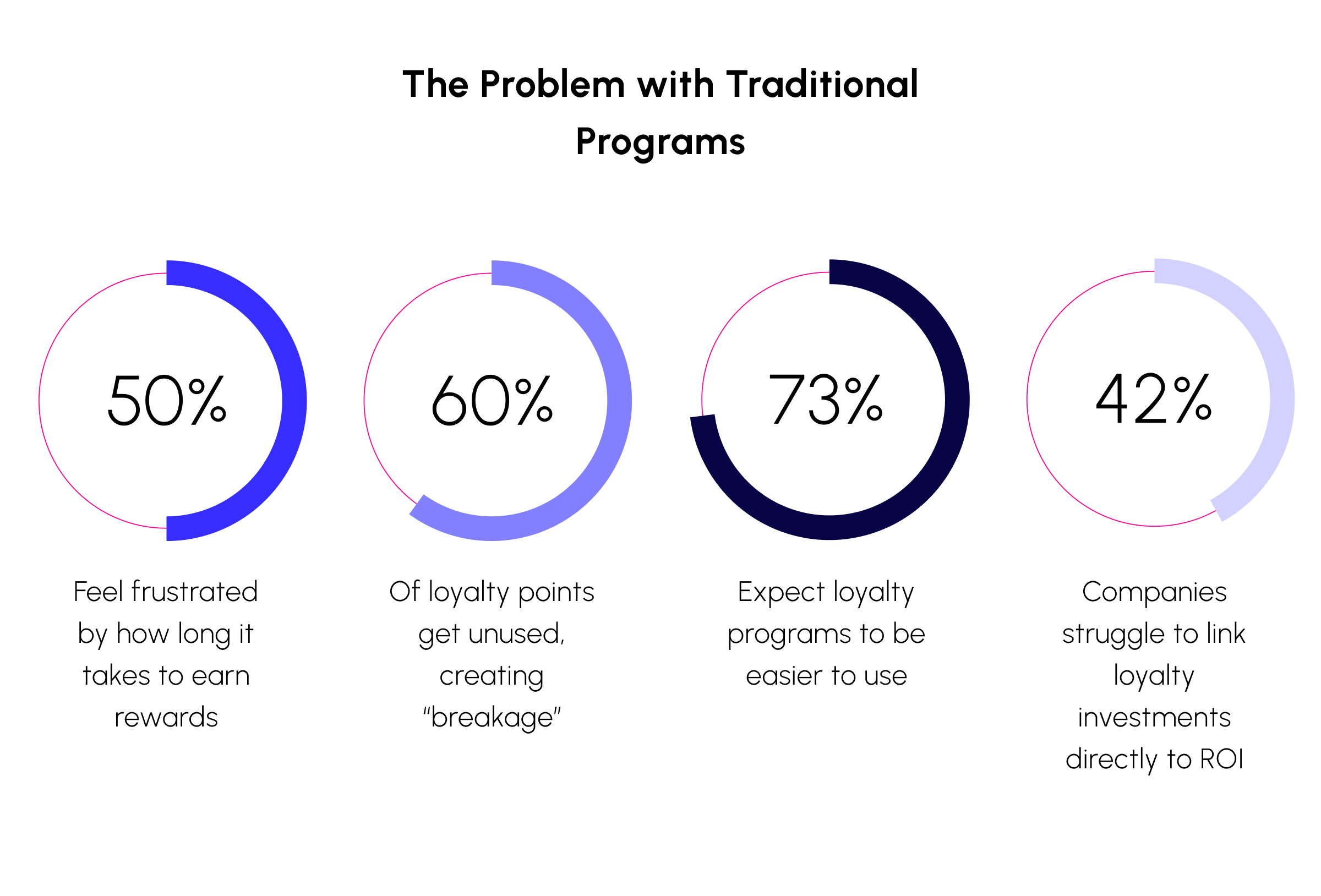
- Delayed rewards that lose impact The biggest weakness is the time lag. Customers have to spend for weeks or months before they can redeem anything meaningful. Research from Bond Brand Loyalty shows that over 50% of customers feel frustrated by how long it takes to earn rewards. Worse, many never get there up to 60% of loyalty points go unused, creating “breakage” that signals disengagement rather than loyalty.
- Participation barriers that drive drop-off Traditional systems ask customers to carry a card, scan an ID, or log into an app. In an era of one-click checkouts and digital wallets, that extra effort feels outdated. PwC found that 73% of consumers expect loyalty programs to be easier to use, but legacy schemes remain clunky.
- Generic offers that fail to connect Sending the same “10% off” coupon to every customer doesn’t build relationships. McKinsey reports that personalised loyalty programs can increase revenue per customer by 5–15% and boost engagement by 20–30%. Yet traditional models rarely deliver personalisation at scale.
- High costs, unclear ROI for businesses Physical cards, custom apps, and legacy IT infrastructure make these programs expensive. But because the data is siloed, businesses can’t clearly measure impact. A Forrester study noted that 42% of companies struggle to link loyalty investments directly to ROI, which undermines confidence in scaling them further.
Traditional loyalty hasn’t failed because the idea is wrong it’s failing because the execution model no longer fits customer behavior or business economics.
The Better Way: Wallet-Based Loyalty
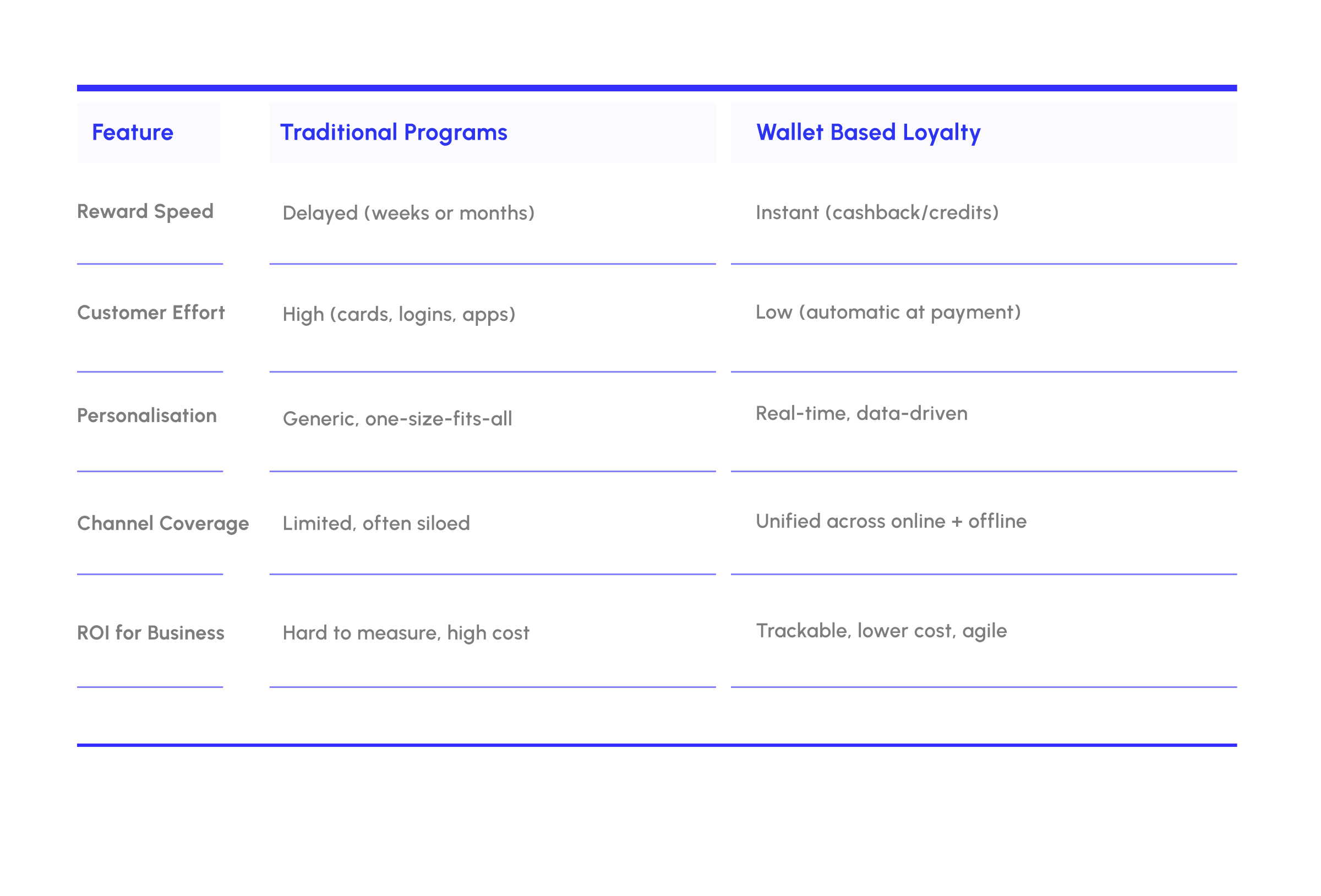
Wallet-based loyalty is not just a digital version of traditional schemes it’s a reimagining of loyalty for the way people shop today. By embedding rewards into digital wallets, businesses remove friction, shorten feedback loops, and create more relevant engagement.
- Instant value that builds trust: Rewards appear immediately as cashback or credits in the wallet. This eliminates waiting and delivers tangible proof of value. Bain research shows that customers who receive instant rewards are twice as likely to return, because the reinforcement is immediate.
- Frictionless participation that raises engagement : Customers don’t have to swipe a card or open an app. The wallet becomes the single point of interaction, and rewards are automatically triggered at payment. This seamless integration ensures higher participation loyalty isn’t something customers remember to do, it just happens.
- Personalised engagement powered by data : Every wallet transaction generates insights into spending behavior. This allows businesses to send targeted offers whether that’s rewarding frequent small purchases or upselling to high-value customers. Accenture notes that 91% of consumers are more likely to engage with brands that recognise, remember, and provide relevant offers exactly what wallets enable.
- Omnichannel coverage that unifies experiences : Wallets work across online, in-store, and mobile. Customers see a single balance and unified rewards journey, no matter how they shop. This consistency not only improves CX but also gives businesses a holistic view of loyalty performance.
Wallet-based loyalty doesn’t just improve loyalty it transforms it into a strategic growth engine that combines ease for customers with measurable ROI for businesses.
Wallet vs Traditional: A Clear Comparison
According to McKinsey, companies that adopt digital-first loyalty models see up to 2.5x higher engagement rates and stronger retention compared to traditional programs.
How we help businesses make the Shift
Shifting from a traditional loyalty scheme to a wallet-based program isn’t just a matter of swapping systems. It requires rethinking loyalty as part of the customer and payment infrastructure rather than a marketing add-on. That’s where FT comes in.
- Consulting-led redesign : We start with strategy, not technology. Our team helps you take a step back and ask the right questions: What role should loyalty play in the overall customer journey? How can it be tied directly to revenue outcomes, not just engagement metrics? This consulting-first approach ensures loyalty isn’t treated as a gimmick but as a core business capability.
- Vendor-agnostic architecture : Many providers push proprietary loyalty solutions that lock businesses into a specific platform. At FT, we take a vendor-agnostic stance. We design loyalty programs that can integrate with existing wallets, payment providers, and tech stacks giving businesses flexibility and future-proofing their investments.
- Seamless technical execution : Our teams specialise in embedding loyalty into digital wallets and payment flows. This means customers can earn, view, and redeem rewards effortlessly across mobile, web, and in-store channels. No clunky add-ons, no broken experiences just a unified system that feels natural for users.
- Data-driven outcomes : Traditional programs often stop at “points earned” or “redemptions made.” With wallet-based loyalty, FT enables real-time analytics that link loyalty activity directly to outcomes: repeat purchase rate, higher average spend, and improved customer lifetime value. Businesses can finally prove ROI with clarity.
With us as a partner, loyalty transforms from a cost-heavy program into an infrastructure advantage that drives measurable growth.
The Future of Loyalty Is Already in the Wallet
The idea behind loyalty hasn’t changed: make customers feel valued so they keep choosing your brand. What has changed is the execution. Traditional programs—delayed, generic, and difficult to use no longer fit today’s digital-first customer expectations.
Wallet-based loyalty represents the next stage. It’s instant, transparent, and personalised, embedded directly in the way customers already pay. For consumers, this creates trust and satisfaction. For businesses, it unlocks lower costs, clearer ROI, and stronger competitive positioning.
The takeaway is clear: the future of loyalty isn’t about plastic cards or forgotten points. It’s about digital wallets that transform every payment into a moment of value.
Book a Strategy Call and let’s reimagine loyalty for the digital age.